
Last Updated on August 26, 2026 by Rocky
The first sales-hiring mistake happens before the first interview. When a sales hire fails, leaders often blame the candidate.
“They interviewed well.”
“They oversold themselves.”
“They just weren’t what we expected.”
Maybe. But in many cases, the breakdown happened long before the candidate ever entered the process. The company began recruiting without first defining exactly what success in the role required. That is not a candidate problem. It is a leadership problem.
A vague sales role creates a vague hiring process. And a vague hiring process produces unpredictable results: long ramp times, missed quotas, turnover, manager frustration, and a revolving door of “promising” salespeople who never quite deliver.
A job title is not a success profile
“Account Executive,” “Business Development Rep,” and “Sales Manager” are titles. They are not clear descriptions of the business results a person must create.
Before looking at a résumé, sales leaders need answers to more meaningful questions:
- What measurable outcomes must this salesperson own?
- What type of sale will they be responsible for: transactional, consultative, technical, complex, new business, account growth, or channel?
- What specific selling competencies will separate a top performer from an average one?
- What strengths must they bring on day one and what skills can reasonably be developed later?
- What behaviors fit the culture, leadership style, and performance expectations of this team?
Without those answers, interviews become a search for familiarity. Leaders hire people who sound confident, have a recognizable background, or remind them of a successful salesperson from the past.
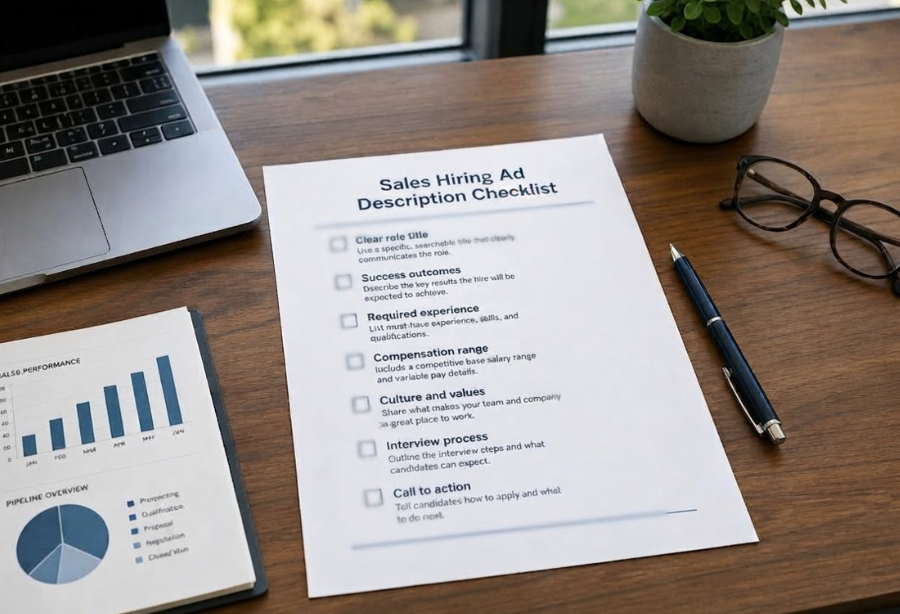
That is not a hiring strategy. It is optimism disguised as judgment.
Define outcomes before evaluating people
The strongest sales organizations begin with the role not the candidate pool.
They identify the outcomes that matter most. For example, a new-business salesperson may need to create pipeline from cold accounts, run discovery conversations with senior decision-makers, manage a long sales cycle, and protect margin while closing business.
That role requires a different person than an account manager responsible for retention, expansion, relationship management, and recurring revenue.
Both may be “great salespeople.” But only one may be right for the work in front of you.
When leaders define outcomes first, they can then identify the competencies that make those outcomes possible. They can distinguish between someone who is merely polished and someone who can actually perform in their selling environment.
The cost of getting it wrong
An undefined sales role creates consequences throughout the business:
- Recruiting attracts the wrong people because the opportunity is unclear.
- Interviews become subjective because there is no shared standard.
- Managers disagree about what “good” looks like.
- Compensation rewards activity that may not support the company’s priorities.
- New hires receive conflicting expectations after they start.
Then, when the salesperson struggles, the organization says it made a bad hire.
The truth may be more uncomfortable: it made an unclear hire.
Precision is a competitive advantage
Top sales talent does not want to walk into ambiguity. High performers want to know what they are being asked to accomplish, how success will be measured, what support they will receive, and whether leadership has built a serious environment for winning.
A clear role definition does more than improve selection. It strengthens attraction, onboarding, accountability, coaching, and retention.
Before you post another opening or meet another “perfect” candidate, stop and ask a more important question:
Have we clearly identified the person this role truly requires?
If the answer is not an unequivocal yes, the next step is not another interview. It is better definition.
Build the role before you fill it
Request the Sales-Hire Success Profile. Email me with the subject line “IDENTIFY” to receive a practical framework for defining sales-role outcomes, required competencies, and non-negotiable strengths before your next search begins.
www.linkedin.com/in/salesdevelopmentexpert , https://www.youtube.com/@rmldeadwood1 , https://x.com/SalesDevelopme3 ,

Rocky is the founder and CEO of Sales Development Expert, bringing over 35 years of hands-on experience in building championship sales teams for more than 2,800 businesses worldwide. As a recognized leader in sales hiring, training, and team development, Rocky is known for his results-driven strategies, deep expertise in sales-specific assessments, and passion for helping companies achieve breakthrough growth.